
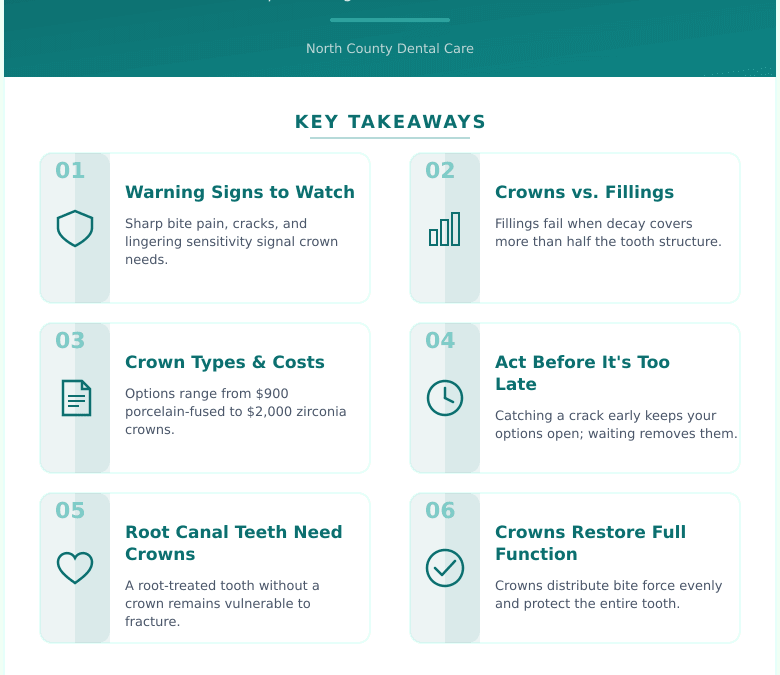
Dental crowns are tooth-shaped caps placed over a damaged or weakened tooth to restore its shape, strength, and function. Getting one at the right time can be the difference between saving a tooth and losing it entirely.
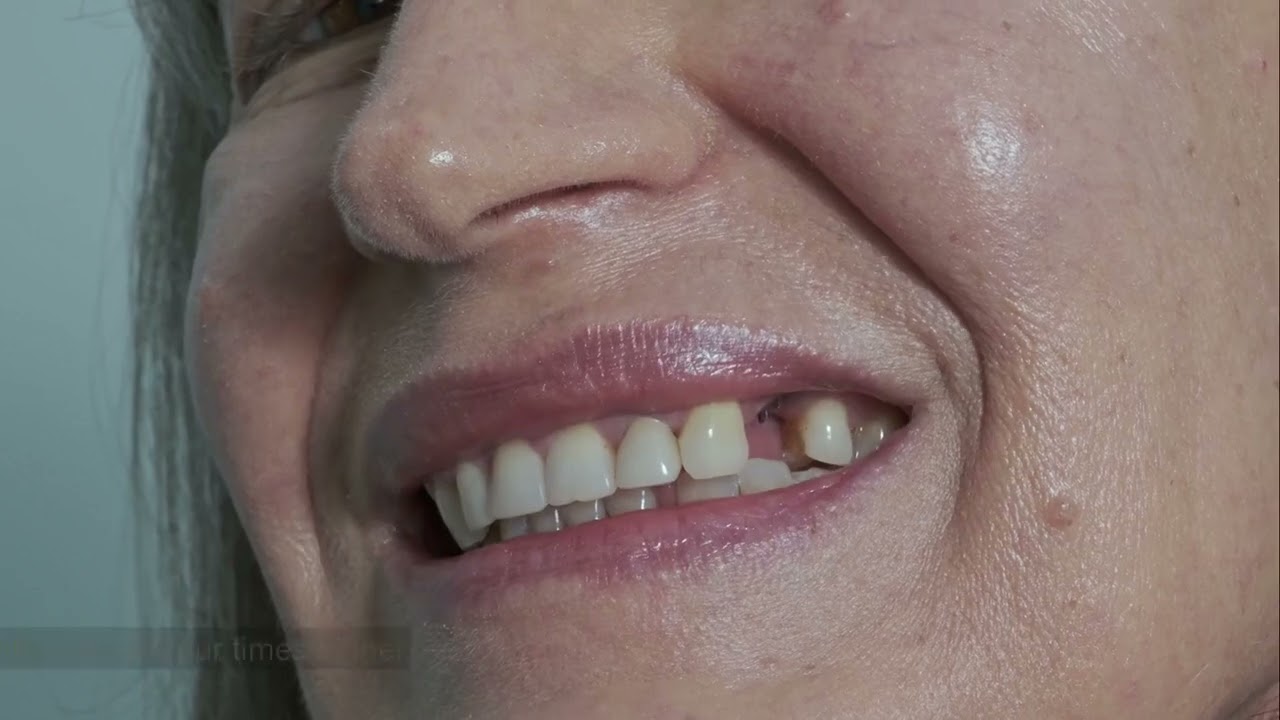
This guide focuses specifically on helping Vista, CA residents recognize when a dental crown is necessary, what the process looks like, and how to make a confident, informed decision about their dental health.
Dental Crown Definition: A dental crown is a fixed prosthetic restoration that fully covers a compromised tooth above the gum line, protecting it from further damage while restoring normal bite function and appearance.
At North County Dental Care, we see patients regularly who waited too long on a tooth that could have been saved with a crown placed earlier. The signs are usually there well before things get serious. You just need to know what to look for.
Warning Signs You Should Not Wait On
Your tooth is trying to tell you something. Here are the red flags that mean a dental crown is likely in your near future.
- Tooth pain that gets sharp when you bite down or chew
- A tooth with a large filling that’s cracking around the edges
- Visible crack lines running across the surface of a tooth
- Sensitivity to hot and cold that lingers longer than a few seconds
- A tooth that has had a root canal and hasn’t been crowned yet
- A tooth that looks noticeably shorter than it used to
Cracked teeth are a serious concern that can contribute to tooth loss when left untreated. Catching a crack before it reaches the root gives you options. Waiting often removes them.
The most common mistake we see is patients treating tooth sensitivity with over-the-counter remedies for months, not realizing the underlying tooth structure is actively failing underneath. Sensitivity is a symptom, not the actual problem. According to the American Dental Association’s guidance on dental crowns, timely placement is critical to preserving compromised tooth structure.
Dental Crowns vs Fillings: Which Approach Works?
Where fillings succeed: Small to moderate cavities, minor chips, and early decay are ideal for fillings. They’re faster, less expensive, and effective when the remaining tooth structure is solid.
Where fillings fail: When a cavity takes up more than about half the tooth, or when the tooth has cracked, a filling can’t provide enough structural support. A large filling can actually accelerate cracking by creating pressure points inside the tooth.
Where crowns succeed: Crowns protect the entire tooth from the outside, distributing bite force evenly. They’re the right call after root canals, for broken cusps, worn-down teeth, and teeth with cracks that stop before the root.
Where crowns fall short: Crowns require removing some healthy tooth structure and cost significantly more than fillings. They also aren’t appropriate when damage extends below the gum line or when the tooth root is compromised.
The verdict: If your dentist is recommending a crown, it’s almost always because a filling simply won’t hold. Skipping a recommended crown to save money usually leads to a more expensive extraction and replacement later.
| Option | Average Cost (2026) | Lifespan | Best For |
|---|---|---|---|
| Composite Filling | $150 – $300 | 5-10 years | Small cavities, minor chips |
| Porcelain Crown | $1,000 – $1,700 | 10-15+ years | Cracked, broken, or root-treated teeth |
| Zirconia Crown | $1,200 – $2,000 | 15-20+ years | Back teeth needing strength and durability |
| Porcelain-Fused-to-Metal Crown | $900 – $1,500 | 10-15 years | Balance of aesthetics and strength |
Cost ranges reflect general U.S. industry averages for 2026 and are not specific to any provider’s fees. Your actual cost will vary based on tooth location, material, and insurance coverage.
Thinking about whether a crown is the right call for your situation? Let’s talk. Contact us and we’ll walk you through your options without any pressure.
What the Dental Crown Process Actually Looks Like
Phase 1: Evaluation and Preparation (Appointment 1)
Your dentist examines the tooth using digital X-rays and sometimes a CBCT (cone beam computed tomography) scan for a 3D view of the root and surrounding bone. If the tooth is approved for a crown, the outer surface is shaped down slightly to make room for the cap.
Key actions during this phase:
- Digital X-rays taken to assess root and bone health
- Tooth is numbed with local anesthetic
- A temporary crown is placed while your permanent one is made
Phase 2: Crown Fabrication (1-2 Weeks)
Impressions or digital scans are sent to a dental lab where your custom crown is created. Some offices now use CAD/CAM (computer-aided design and manufacturing) technology to make same-day crowns in a single visit, which is worth asking about.
Phase 3: Placement and Final Fit (Appointment 2)
Your permanent crown is checked for fit, bite, and color match before being cemented into place. Most patients leave with no restrictions beyond avoiding very sticky foods for the first 24 hours.
Your Dental Crown Action Plan
- Step 1 – Schedule a full exam: Don’t wait for pain to become unbearable. A routine checkup can catch cracks and decay before a crown becomes urgent.
- Step 2 – Ask about crown material options: Porcelain works well for front teeth. Zirconia is typically better for molars where bite pressure is higher. Your dentist can guide you based on your specific tooth.
- Step 3 – Check your insurance: Most dental plans cover 50% of crown costs after your deductible. Call your insurer before your appointment so there are no surprises.
- Step 4 – Prepare for your appointment: Eat a full meal beforehand since you may be numb for a couple of hours after the procedure.
- Step 5 – Protect your investment: Crowned teeth still need brushing and flossing. The crown protects the tooth, but decay can still form at the gum line around it.
Pre-Appointment Checklist:
- ☐ Review your dental insurance coverage and annual maximum
- ☐ List any medications you’re currently taking for your dentist
- ☐ Eat before your appointment
- ☐ Arrange a ride home if you’re nervous about numbness while driving
- ☐ Prepare any questions about material options or the timeline
What Vista Residents Should Know About Insurance and Costs
California dental insurance plans typically categorize crowns as a major restorative procedure, covering 40-50% after your deductible is met. Out-of-pocket costs in the Vista area generally follow national averages, though prices vary by provider and material chosen.
Recent data shows that patients who delay recommended crowns and eventually require extraction and implant replacement pay an average of 3 to 4 times more than they would have spent on the crown alone. That gap is worth thinking about. The National Institute of Dental and Craniofacial Research’s overview of tooth decay underscores how untreated dental damage consistently escalates in both severity and cost over time.
Serving patients from Vista, Oceanside, San Marcos, Carlsbad, Escondido, and throughout northern San Diego County, North County Dental Care is located at 1000 East Vista Way, Vista, CA 92084. Our team is here to answer your questions and help you understand your options clearly before any decision is made.
Ready to take the next step? Contact us today for straight answers and real solutions. Your tooth isn’t going to feel better on its own, and the sooner we look at it, the better your options are.
Key Takeaways for Vista Patients in 2026
- Pain when biting is a red flag – it usually means the tooth structure is compromised and needs evaluation now
- Crowns outperform large fillings – once decay or damage covers more than half the tooth, a filling won’t protect it long-term
- Material selection matters – zirconia for molars, porcelain for front teeth, your dentist can help you choose
- Insurance typically covers half – verify your plan’s major restorative coverage before your appointment in 2026
- Waiting costs more – a delayed crown often becomes a much more expensive extraction and implant later
Frequently Asked Questions
How long do dental crowns typically last?
Most dental crowns last between 10 and 15 years, with zirconia crowns often exceeding 20 years with good care. Longevity depends on material, placement location, and daily habits like grinding or clenching.
Does getting a dental crown hurt?
The procedure itself is done under local anesthetic, so most patients feel only pressure, not pain. Mild soreness around the gum tissue can occur for a day or two after the appointment and usually responds well to over-the-counter pain relief.
How much do dental crowns cost without insurance?
Without insurance, crowns typically range from $900 to $2,000 per tooth nationally as of 2026, depending on material and tooth location. These are general industry averages and actual fees vary by provider.
Is a dental crown covered by insurance?
Most dental insurance plans cover 40-50% of crown costs once your deductible is satisfied, up to your annual maximum. Some plans require a waiting period for major restorative work, so it’s worth checking your specific policy before scheduling.
What happens if I skip a recommended crown?
A compromised tooth without a crown will continue to break down, often resulting in infection, root damage, or complete tooth loss. At that point, your options shift to extraction followed by an implant or bridge, which costs considerably more than a crown would have.
Can a crowned tooth get a cavity?
The crown itself cannot decay, but the natural tooth structure at the gum line where the crown meets the tooth absolutely can. Brushing and flossing around crowned teeth is just as important as with natural teeth.
How do I know if I need a crown or a root canal?
A root canal treats infection inside the tooth pulp, while a crown protects the outer tooth structure – and most root canal-treated teeth actually need a crown afterward. Your dentist will use X-rays and clinical exam to determine which is needed based on where the damage or infection is located.
Recent Comments